158. 用 Read4 读取 N 个字符 II - 多次调用 🔒
题目描述
给你一个文件 file ,并且该文件只能通过给定的 read4 方法来读取,请实现一个方法使其能够使 read 读取 n 个字符。注意:你的 read 方法可能会被调用多次。
read4 的定义:
read4 API 从文件中读取 4 个连续的字符,然后将这些字符写入缓冲区数组 buf4 。
返回值是读取的实际字符数。
请注意,read4() 有其自己的文件指针,类似于 C 中的 FILE * fp 。
    参数类型: char[] buf4
    返回类型: int

注意: buf4[] 是目标缓存区不是源缓存区,read4 的返回结果将会复制到 buf4[] 当中。
下列是一些使用 read4 的例子:
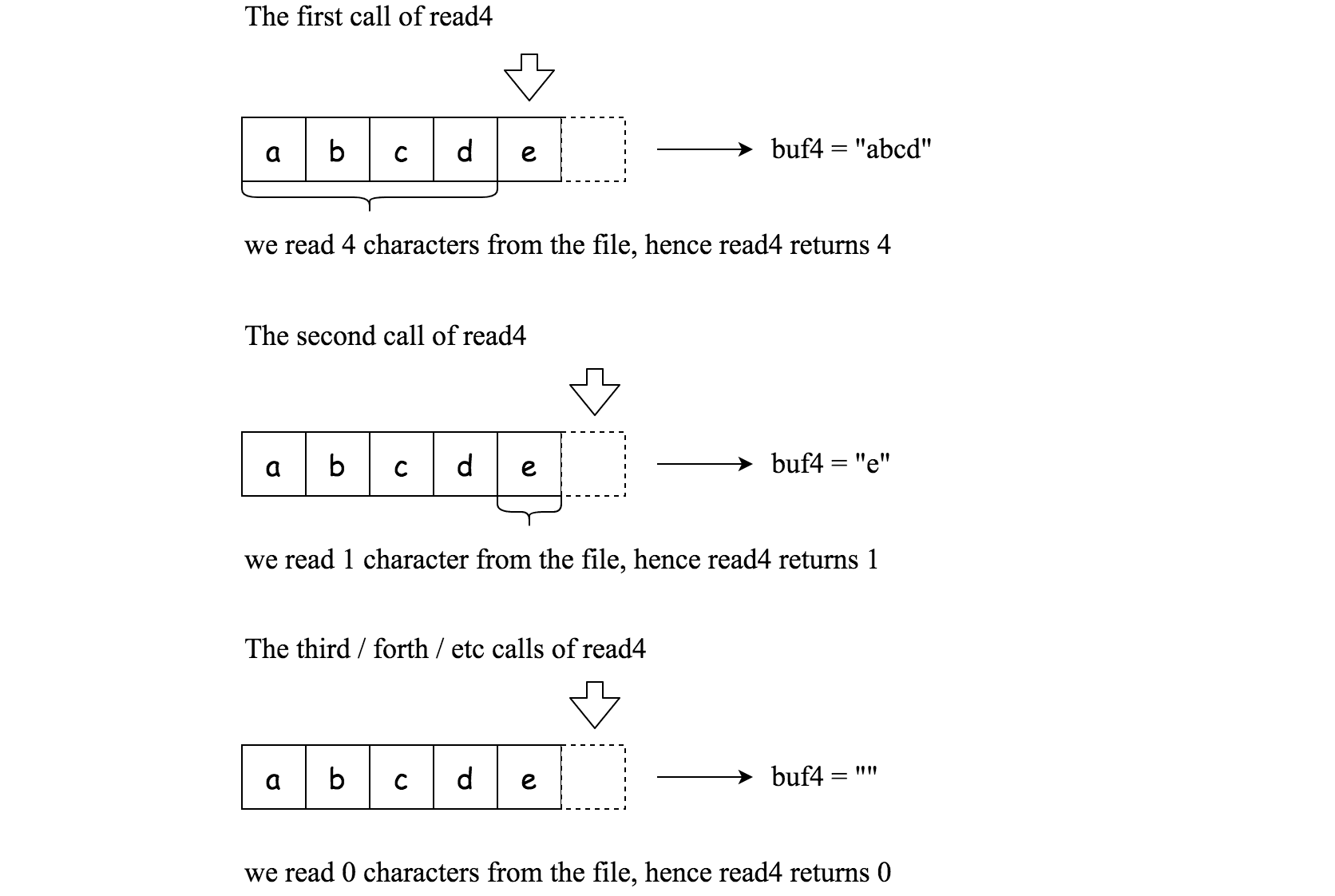
File file("abcde"); // 文件名为 "abcde", 初始文件指针 (fp) 指向 'a'
char[] buf4 = new char[4]; // 创建一个缓存区使其能容纳足够的字符
read4(buf4); // read4 返回 4。现在 buf4 = "abcd",fp 指向 'e'
read4(buf4); // read4 返回 1。现在 buf4 = "e",fp 指向文件末尾
read4(buf4); // read4 返回 0。现在 buf4 = "",fp 指向文件末尾
read 方法:
通过使用 read4 方法,实现 read 方法。该方法可以从文件中读取 n 个字符并将其存储到缓存数组 buf 中。您 不能 直接操作 file 。
返回值为实际读取的字符。
read 的定义:
    参数类型:  char[] buf, int n
    返回类型:  int

注意: buf[] 是目标缓存区不是源缓存区,你需要将结果写入 buf[] 中。
注意:
- 你 不能 直接操作该文件,文件只能通过
read4获取而 不能 通过read。 read函数可以被调用 多次。- 请记得 重置 在 Solution 中声明的类变量(静态变量),因为类变量会 在多个测试用例中保持不变,影响判题准确。请 查阅 这里。
- 你可以假定目标缓存数组
buf保证有足够的空间存下 n 个字符。 - 保证在一个给定测试用例中,
read函数使用的是同一个buf。
示例 1:
输入: file = "abc", queries = [1,2,1]
输出:[1,2,0]
解释:测试用例表示以下场景:
File file("abc");
Solution sol;
sol.read (buf, 1); // 调用 read 方法后,buf 应该包含 “a”。我们从文件中总共读取了 1 个字符,所以返回 1。
sol.read (buf, 2); // 现在 buf 应该包含 "bc"。我们从文件中总共读取了 2 个字符,所以返回 2。
sol.read (buf, 1); // 我们已经到达文件的末尾,不能读取更多的字符。所以返回 0。
假设已经分配了 buf ,并保证有足够的空间存储文件中的所有字符。
示例 2:
输入:file = "abc", queries = [4,1]
输出:[3,0]
解释:测试用例表示以下场景:
File file("abc");
Solution sol;
sol.read (buf, 4); // 调用 read 方法后,buf 应该包含 “abc”。我们从文件中总共读取了 3 个字符,所以返回 3。
sol.read (buf, 1); // 我们已经到达文件的末尾,不能读取更多的字符。所以返回 0。
提示:
1 <= file.length <= 500file由英语字母和数字组成1 <= queries.length <= 101 <= queries[i] <= 500
解法
方法一:模拟
Python3
# The read4 API is already defined for you.
# def read4(buf4: List[str]) -> int:


class Solution:
    def __init__(self):
        self.buf4 = [None] * 4
        self.i = self.size = 0

    def read(self, buf: List[str], n: int) -> int:
        j = 0
        while j < n:
            if self.i == self.size:
                self.size = read4(self.buf4)
                self.i = 0
                if self.size == 0:
                    break
            while j < n and self.i < self.size:
                buf[j] = self.buf4[self.i]
                self.i += 1
                j += 1
        return j
Java
/**
 * The read4 API is defined in the parent class Reader4.
 *     int read4(char[] buf4);
 */

public class Solution extends Reader4 {
    private char[] buf4 = new char[4];
    private int i;
    private int size;

    /**
     * @param buf Destination buffer
     * @param n   Number of characters to read
     * @return    The number of actual characters read
     */
    public int read(char[] buf, int n) {
        int j = 0;
        while (j < n) {
            if (i == size) {
                size = read4(buf4);
                i = 0;
                if (size == 0) {
                    break;
                }
            }
            while (j < n && i < size) {
                buf[j++] = buf4[i++];
            }
        }
        return j;
    }
}
C++
/**
 * The read4 API is defined in the parent class Reader4.
 *     int read4(char *buf4);
 */

class Solution {
public:
    /**
     * @param buf Destination buffer
     * @param n   Number of characters to read
     * @return    The number of actual characters read
     */
    int read(char* buf, int n) {
        int j = 0;
        while (j < n) {
            if (i == size) {
                size = read4(buf4);
                i = 0;
                if (size == 0) break;
            }
            while (j < n && i < size) buf[j++] = buf4[i++];
        }
        return j;
    }

private:
    char* buf4 = new char[4];
    int i = 0;
    int size = 0;
};
Go
/**
 * The read4 API is already defined for you.
 *
 *     read4 := func(buf4 []byte) int
 *
 * // Below is an example of how the read4 API can be called.
 * file := File("abcdefghijk") // File is "abcdefghijk", initially file pointer (fp) points to 'a'
 * buf4 := make([]byte, 4) // Create buffer with enough space to store characters
 * read4(buf4) // read4 returns 4. Now buf = ['a','b','c','d'], fp points to 'e'
 * read4(buf4) // read4 returns 4. Now buf = ['e','f','g','h'], fp points to 'i'
 * read4(buf4) // read4 returns 3. Now buf = ['i','j','k',...], fp points to end of file
 */

var solution = func(read4 func([]byte) int) func([]byte, int) int {
	buf4 := make([]byte, 4)
	i, size := 0, 0
	// implement read below.
	return func(buf []byte, n int) int {
		j := 0
		for j < n {
			if i == size {
				size = read4(buf4)
				i = 0
				if size == 0 {
					break
				}
			}
			for j < n && i < size {
				buf[j] = buf4[i]
				i, j = i+1, j+1
			}
		}
		return j
	}
}